Miskolc Hospital Joins the IASIOS International Accreditation Programme
Borsod24.hu
This feature explores how Miskolc Hospital became one of the internationally recognised centres within the IASIOS accreditation programme. The article highlights the hospital’s expertise in interventional oncology, the importance of internationally recognised quality standards, and how IASIOS membership will support future education, research collaboration, and the continued development of advanced, minimally invasive cancer treatments.
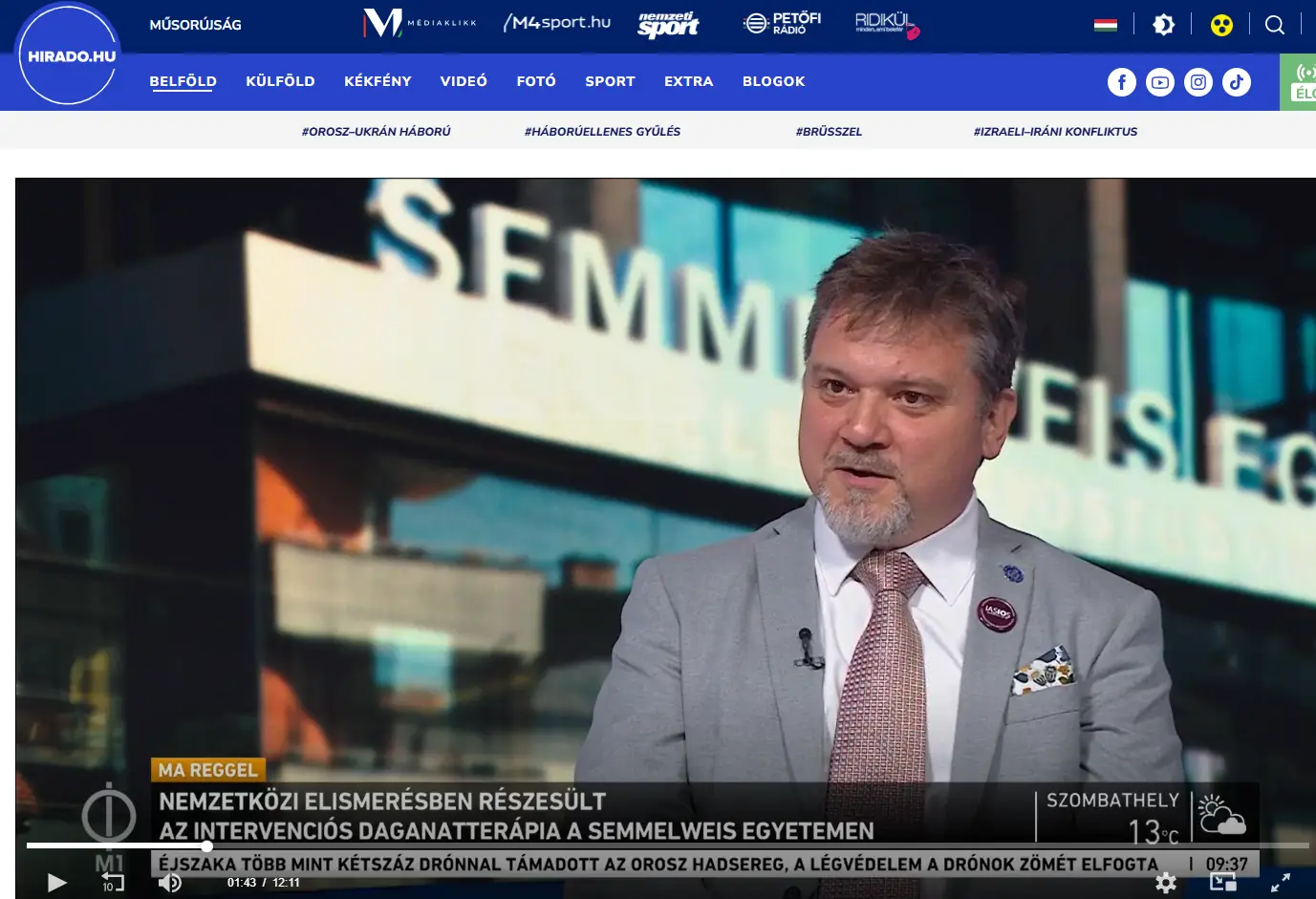
Interventional Oncology at Semmelweis University Receives International Recognition
Ma Reggel (“This Morning”) on the Hungarian television channel M1
Watch the news coverage highlighting the international recognition received by the Onco-Interventional Department at Semmelweis University. The segment features Dr. Pál Ákos Deák discussing the importance of IASIOS accreditation and what this milestone means for the advancement of high-quality interventional oncology care in Hungary and the region.
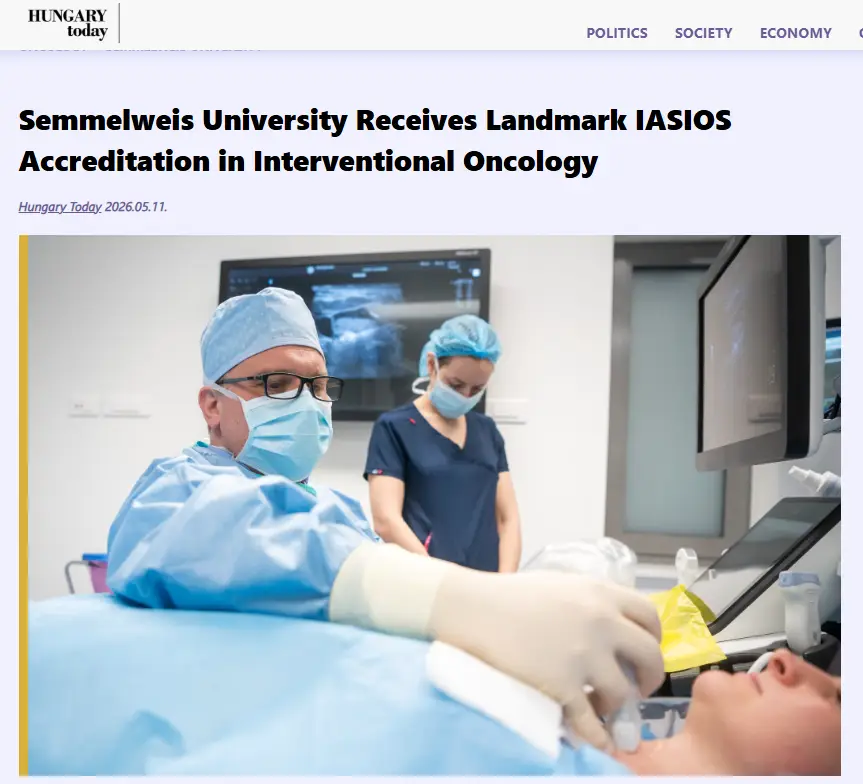
Semmelweis University Receives Landmark IASIOS Accreditation in Interventional Oncology
Hungary Today
Read the article on Semmelweis University becoming the first IASIOS Accredited Centre in Hungary and the Central and Eastern European region. The feature highlights how the accreditation recognises the university’s commitment to high-quality, minimally invasive cancer care and internationally aligned standards in interventional oncology. It also explores the growing role of interventional radiology in modern oncology treatment, education, and patient-centred care.
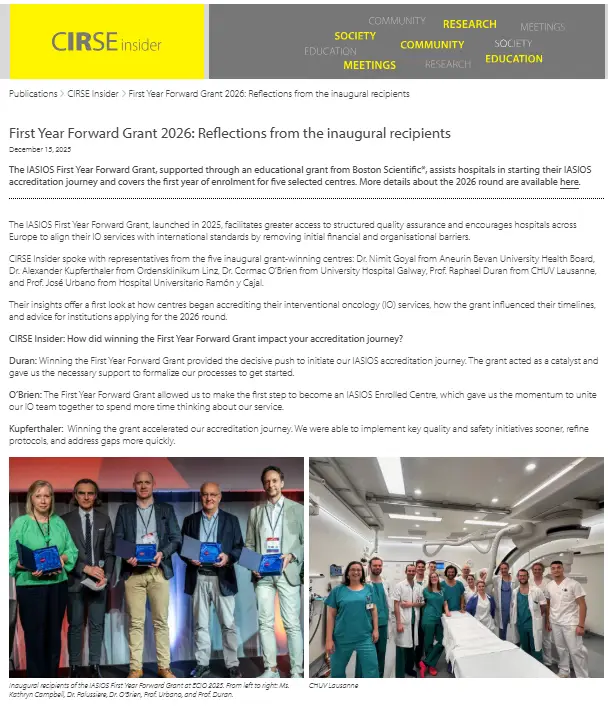
First Year Forward Grant 2026: Reflections from the inaugural recipients
Read the CIRSE Insider article featuring reflections from the inaugural recipients of the IASIOS First Year Forward Grant. Representatives from five centres share how the grant supported their accreditation journey, strengthened quality initiatives, and helped advance interventional oncology services within their institutions. Discover their experiences, insights, and advice for centres considering applying for the next round.
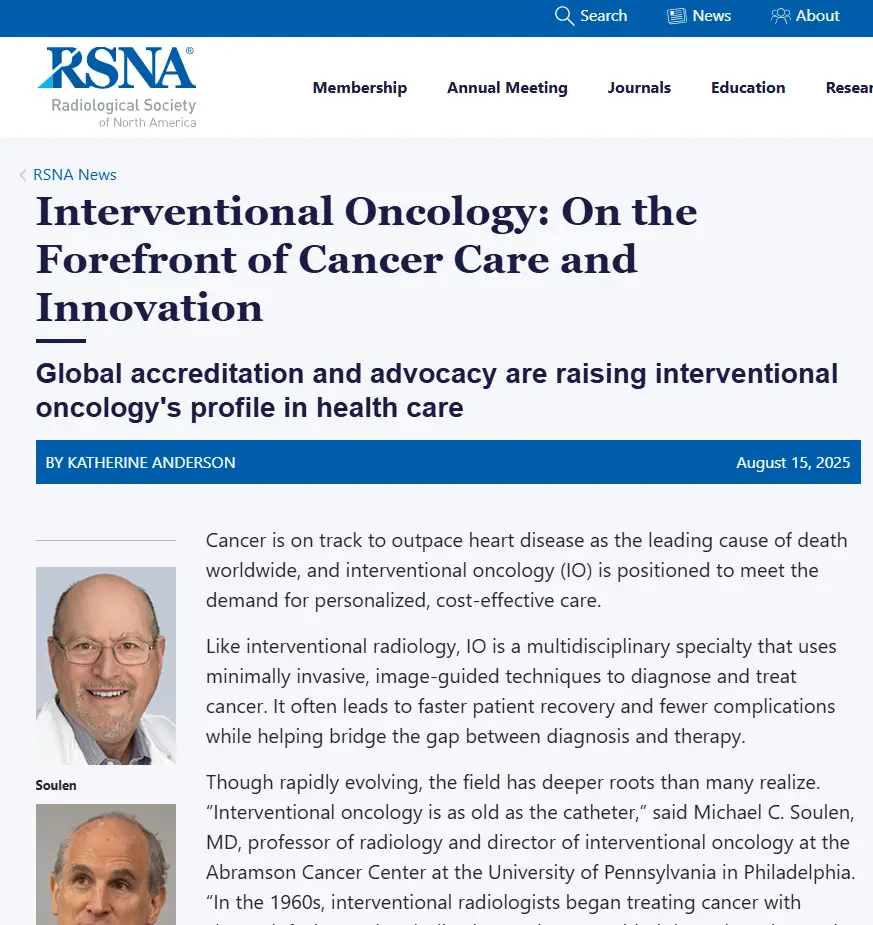
Interventional Oncology: On the Forefront of Cancer Care and Innovation
RSNA News
The RSNA News article Interventional Oncology: On the Forefront of Cancer Care and Innovation highlights the growing importance of interventional oncology and emphasizes how the International Accreditation System for Interventional Oncology Services (IASIOS) is helping to set global standards for quality and safety. Since its launch in 2021, IASIOS has accredited more than 30 centres worldwide, with the Mallinckrodt Institute of Radiology becoming the first in the U.S. to achieve accreditation. By standardizing practice, improving safety protocols, and enhancing credibility with patients and physicians, IASIOS is raising the profile of interventional oncology and supporting its recognition as a key pillar of modern cancer care. Read the full article to learn more about how IASIOS is driving this progress.
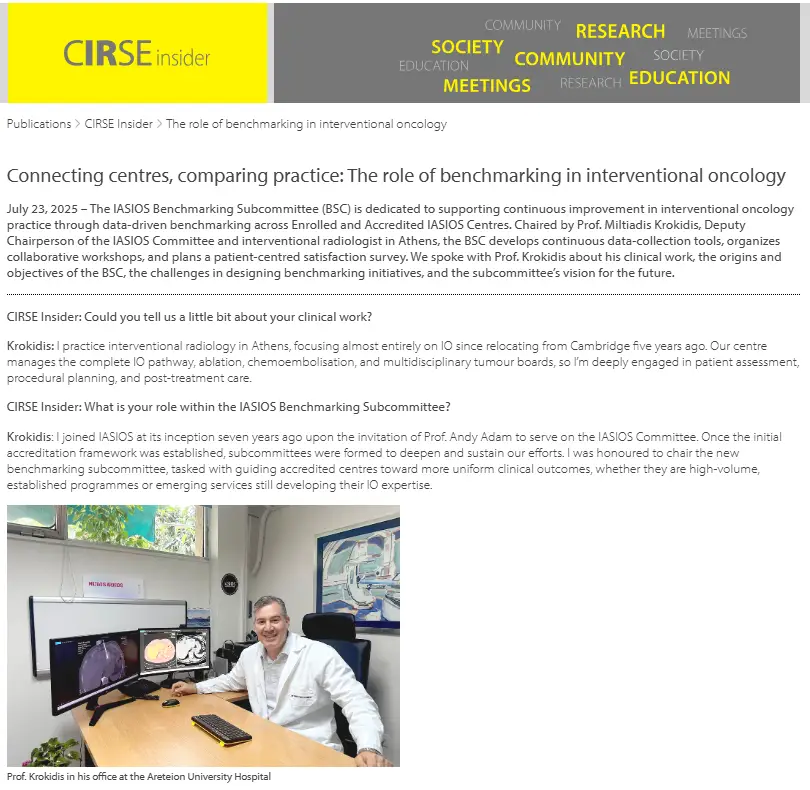
Connecting centres, comparing practice: The role of benchmarking in interventional oncology
CIRSE Insider
The IASIOS Benchmarking Subcommittee, chaired by Prof. Miltiadis Krokidis, is advancing interventional oncology by fostering collaboration and data-driven improvement across centres. In this interview, Prof. Krokidis discusses the value of benchmarking for quality assurance, the subcommittee’s early initiatives, and its plans to expand data collection, workshops, and patient-focused measures. He also reflects on his personal motivation and offers guidance for centres considering IASIOS accreditation. Read the full article to learn how benchmarking is shaping continuous progress in interventional oncology.
The evolution of interventional oncology: pioneering a new era in cancer care
Volume 1, article number 1, (2025)
In this editorial, Philippe L. Pereira and Thomas Helmberger trace the evolution of interventional oncology from a subspecialty of interventional radiology to a recognised fourth pillar of cancer care. They discuss the field’s rapid progress, its growing role in multidisciplinary treatment, and emerging synergies with immunotherapy. The article also highlights IASIOS accreditation as a key element in ensuring standardised, high-quality care across institutions, helping to establish shared benchmarks and strengthen IO’s role within the wider oncology community.
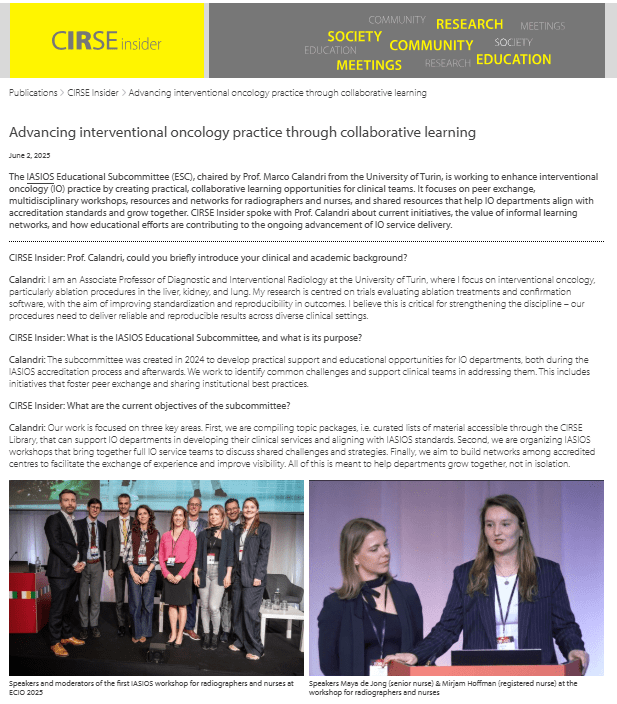
Advancing interventional oncology practice through collaborative learning
CIRSE Insider
The IASIOS Educational Subcommittee, led by Prof. Marco Calandri, is advancing interventional oncology through team-based learning and peer exchange. At ECIO 2025, the first IASIOS Workshop for Radiographers and Nurses highlighted best practices in IO care, from follow-up to intraprocedural teamwork. New initiatives include a communication course for tumour board meetings to strengthen IO’s role in multidisciplinary care. Prof. Calandri also reflects on how IASIOS accreditation has brought his team closer and improved internal processes.
Read the full article to learn more.
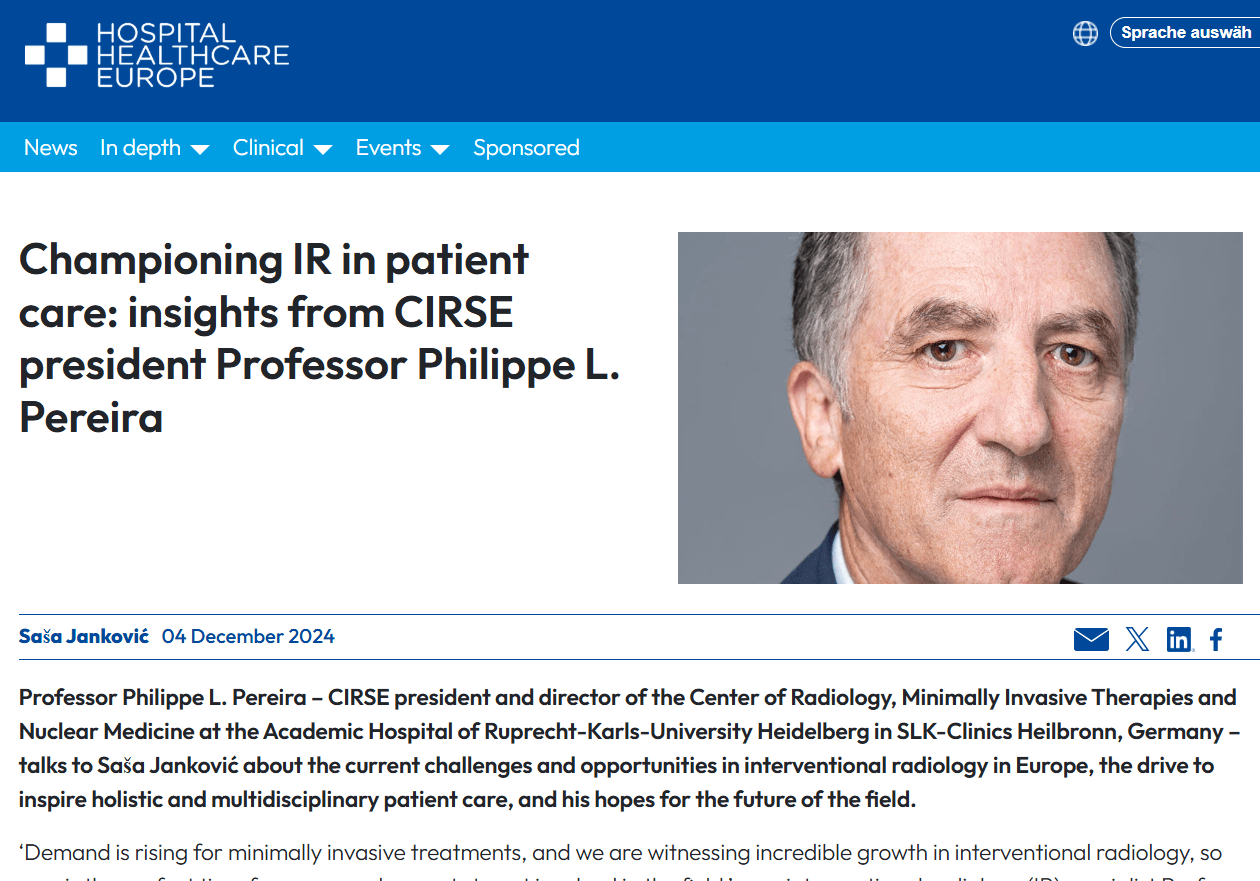
Championing IR in patient care: insights from CIRSE president Professor Philippe L. Pereira
Hospital Healthcare Europe
In this interview, CIRSE president Philippe L. Pereira discusses the growth of interventional radiology, the need for better training pathways, and the importance of multidisciplinary collaboration. He highlights IASIOS accreditation as a key step in ensuring high-quality interventional oncology services, recognizing hospitals that integrate patient-centred care with advanced, minimally invasive treatments.
CIRSE Clinical Practice Survey: Patient safety and quality improvement in IR
Interventional News
In this article, Andreas Mahnken (University Hospital Marburg, Germany) highlights key findings from the CIRSE Clinical Practice Survey on patient safety and quality improvement in interventional radiology. The survey revealed strong engagement, with over half of respondents having direct patient access, 77.3% using safety checklists, and 68.1% participating in quality improvement activities. CIRSE is using these insights to enhance clinical practice support, including through the International Accreditation System for Interventional Oncology Services (IASIOS).