


TARE

TARE is a targeted treatment for liver cancer that uses tiny radioactive beads (microspheres) to deliver radiation directly to the tumour. These beads block the tumour’s blood supply and release radiation over time, helping to shrink or control its growth while reducing damage to healthy tissue.

TARE is usually a safe procedure, but like any medical treatment, it does have some risks.
🔸 Most people have only mild and temporary side effects, which happen in about 1 in 5 patients.
🔸 You might feel tired, have mild stomach pain or discomfort, or experience nausea and a low fever.
🔸 These symptoms usually go away on their own and can be managed with medication if needed.
🔸 Some people may also have temporary changes in liver function, which your doctor will monitor closely.
🔸 More serious complications are rare, affecting about 2 in 100 patients.
🔸 In very few cases, TARE can lead to liver failure, infections, damage to nearby organs, or injury to blood vessels.

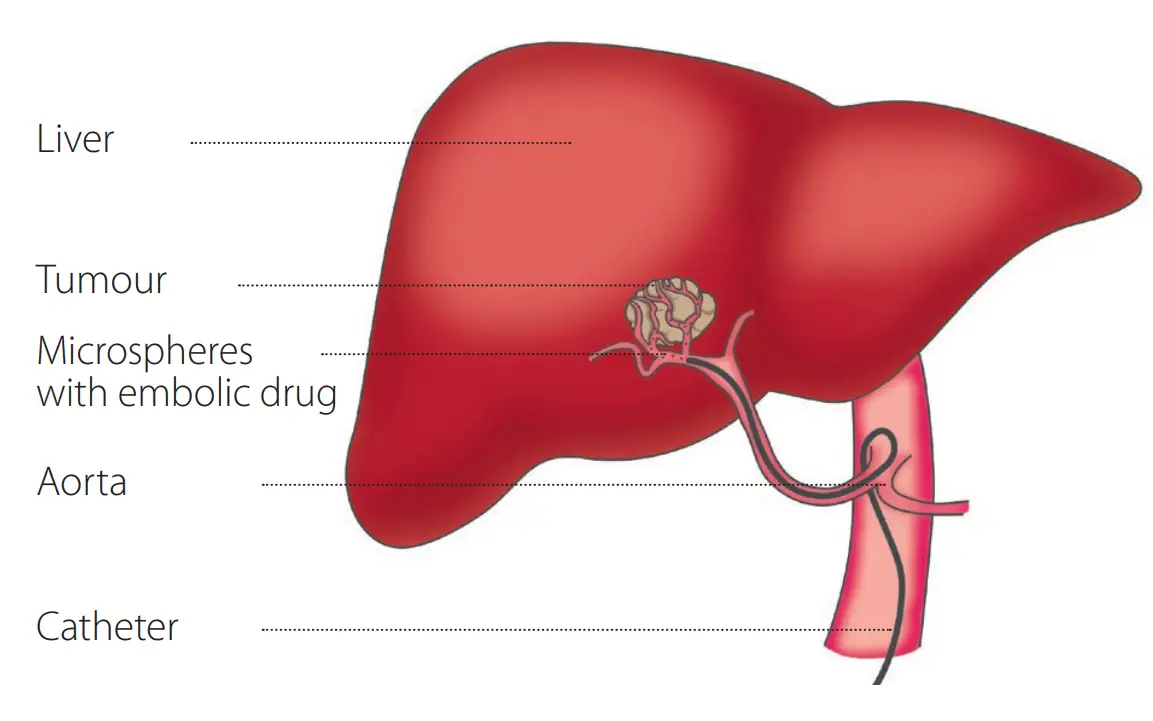
First is a test dose with a MAA (macroaggregated albumin) injection (diagnostic phase) followed by a scan called scintigraphy. This helps doctors check if the radiation could travel to the lungs or other organs and calculate the right dosimetry.
The second step is the therapeutic phase, where tiny radioactive beads are injected.
Procedure:
-
After numbing the skin with local anesthesia, the doctor inserts a thin needle followed by a small wire into an artery in your groin or wrist.
-
A flexible tube (catheter) is then guided through the artery until it reaches the blood vessels that supply the tumor in the liver.
-
In the first step (diagnostic), MAA is injected. In the second step (therapeutic) tiny radioactive beads are injected into the artery.
-
In the therapeutic phase, these beads get trapped in the tumor, blocking its blood supply and releasing radiation over time.
-
The catheter is carefully removed, and the opening where it was inserted is closed. The procedure usually takes 1 hour.

The treatment for liver cancer depends on factors like the size and location of the tumour, your overall health, and whether the cancer has spread. You might need one or more of these treatments:
Alternative 1 – Surgery: This could mean either removing part of the liver (partial hepatectomy) or replacing the liver with a healthy one from a donor (liver transplant). Not everyone will be able to have surgery.
Alternative 2 – Ablation: A minimally invasive procedure where a thin wand is inserted through the skin to destroy the tumour using heat or freezing. This works best for small tumours and may cure the cancer.
Alternative 3 – Transarterial Chemoembolization (TACE): A minimally invasive procedure that delivers chemotherapy directly into the tumour’s blood supply to shrink it. These treatments are often used for larger or multiple tumours.
Alternative 4 – Radiation Therapy: External Beam Radiation Therapy (EBRT): a series of treatments that use radiation beams from outside the body to destroy the tumour.
Alternative 5 – Systemic Therapies: Targeted therapy, immunotherapy (helping the immune system fight cancer) and chemotherapy. If the cancer has spread, these treatments help control the disease throughout the body.

After the procedure, you will be monitored in the recovery area. If you experience any pain or nausea, medications will be given to help you feel more comfortable.
Many patients go through post-embolization syndrome, which can cause mild pain, nausea, or fever. These symptoms usually don’t last long and can be easily managed with medication.
Usually, patients can go home within 24-48 hours after the procedure.
❌ Avoid close contact with children, pregnant women, or animals for 3-7 days.
❌ No public transportation with more than 2 hours next to a person for 3-7 days.
Follow up:
- A few weeks after treatment, your doctor will do blood tests to check how your liver and kidneys are working .
- 1 to 3 months later, a CT or MRI scan will show how well the treatment worked.
- Your doctor will go over the results with you and talk about the next steps based on your progress. will discuss the next steps based on your results and progress.
Regular follow-ups are important to make sure the tumor has been effectively treated and to monitor for any signs of recurrence.
❗Contact your doctor immediately if you have:
- Pale or cold legs
- Bleeding from the groin or wrist
- Significant shortness of breath
- Frequent diarrhoea
- Uncontrollable abdominal pain or cramping
- Fever of 38°C (100.4°F) or higher
Image source: https://www.cirse.org/wp-content/uploads/2020/08/Transarterial-chemoembolisation.pdf
This page contains general medical information. The information is not intended or implied to be a substitute for professional medical advice, diagnosis or treatment